
How long will it take? When will I be able to communicate in Spanish? These are some of the first questions that come up when you finally decide to learn Spanish.
And the honest answer is: it depends.
As a private Spanish teacher with 15 years of experience teaching adults one-to-one, I can tell you that a few key factors will influence how long it takes to communicate comfortably in Spanish.
What do you mean by “learning Spanish”?
Before anything else, it's important to define what you mean by learning Spanish.
There is a big difference between being able to order food in a restaurant and having a deep, interesting conversation with native speakers.
In the first case, basic vocabulary and a bit of grammar are enough.
In the second one, you need much more. You need to understand different tenses, recognize humour, understand cultural references, and sometimes even slang.
That's why, when someone asks me, "When will I be able to communicate in Spanish?", my answer is usually:
"At what level do you want to communicate?"
Ask yourself: How much time and energy can you give?
During the last 15 years, I have worked with many students, and one thing has become very clear to me:
Your progress in Spanish will largely depend on how much time and energy you are willing to invest.
Of course, everyone learns at a different pace. But in general, the students who make the biggest progress are those who find a way to make Spanish a regular part of their lives.
This includes:
- quality time with your teacher or mentor
- time you spend learning on your own
And also:
- how intensive your learning process is
- your teacher's strategy and competence
- whether you connect well as people
- your motivation and consistency
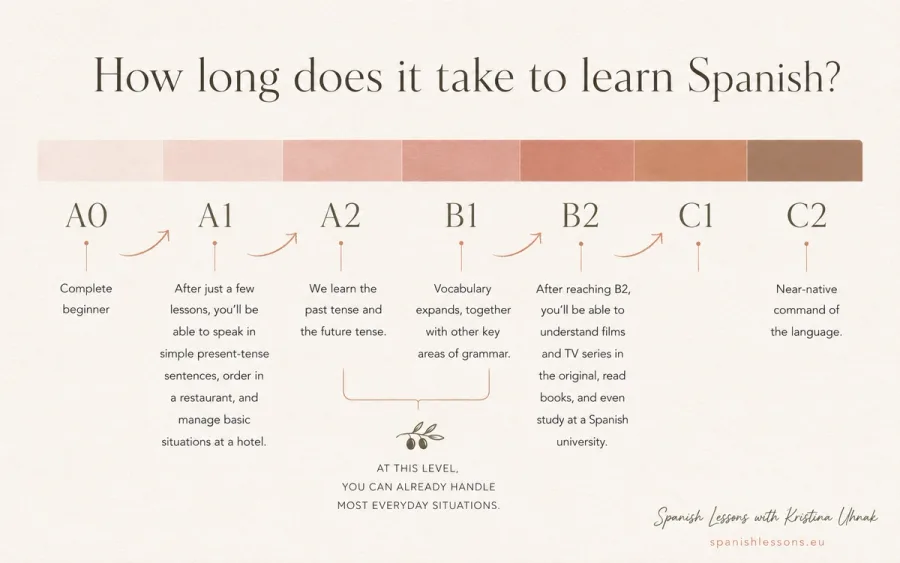
So, how long does it really take?
Language levels are usually divided into stages.
The A0 level means a complete beginner — someone who doesn't speak the language at all, or maybe knows just a few isolated words.
What most of my students imagine as day-to-day communication is somewhere between A2 and B1 level.
As a general rule, moving from one level to another (for example, from A0 to A1) takes about 100 active hours of learning.
This includes:
- real conversations and structured lessons with your teacher or mentor
- doing homework
- listening to podcasts
- reading
- writing short texts, notes, or a diary in Spanish, translating short texts or sentences
- learning vocabulary
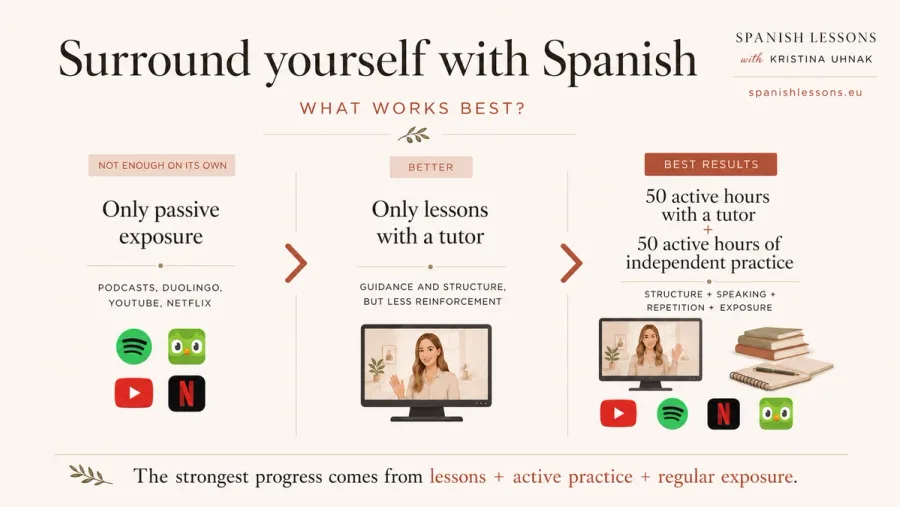
I see the best results in students who combine these activities in a balanced way. For example, if you only rely on lessons with your private tutor, you may not get the same results as someone who combines lessons with independent practice.
A student who spends 50 hours in lessons and another 50 hours actively engaging with the language will usually progress much faster.
This is especially true for many of my students who have moved to Spain and want to feel more confident in everyday situations. Whether it's talking to neighbours, communicating with their child's school, visiting a doctor, or making local friends, regular contact with the language makes a huge difference.
And if you add enjoyable exposure, such as series, music, podcasts, or books, the results are even better.
My approach
Many of my students start as complete beginners. And yet they begin speaking Spanish from the very first lesson. In simple words and short phrases, of course, but they speak. Because the truth is simple: To learn something, you have to do it. You don't learn a language by thinking about it. You learn it by using it.
Of course, during the first weeks we talk about simple topics. But building a solid foundation and following a well-structured strategy is what really helps you move towards your goal.
I often compare language learning to building a house. You need a strong foundation first. Only then can you work on the facade and the small details inside. If the foundation is weak, everything else will feel unstable. If it's strong, everything becomes easier.
That's why I don't believe in shortcuts. I believe in building something that lasts. If you really want to learn Spanish, one of the best things you can do is make the learning process a pleasant ritual and surround yourself with the language as much as possible.
How to really learn Spanish?
Focus on building a system that works for you.
Stay consistent.
And most importantly, actually use the language.
If you'd like someone to help you create the right strategy, feel free to contact me. I'll be happy to adapt the course to your daily life, so that the process stays enjoyable, realistic, and sustainable. Because the truth is simple: The decision you make today will shape your Spanish one year from now.
Un abrazo,
Kristina